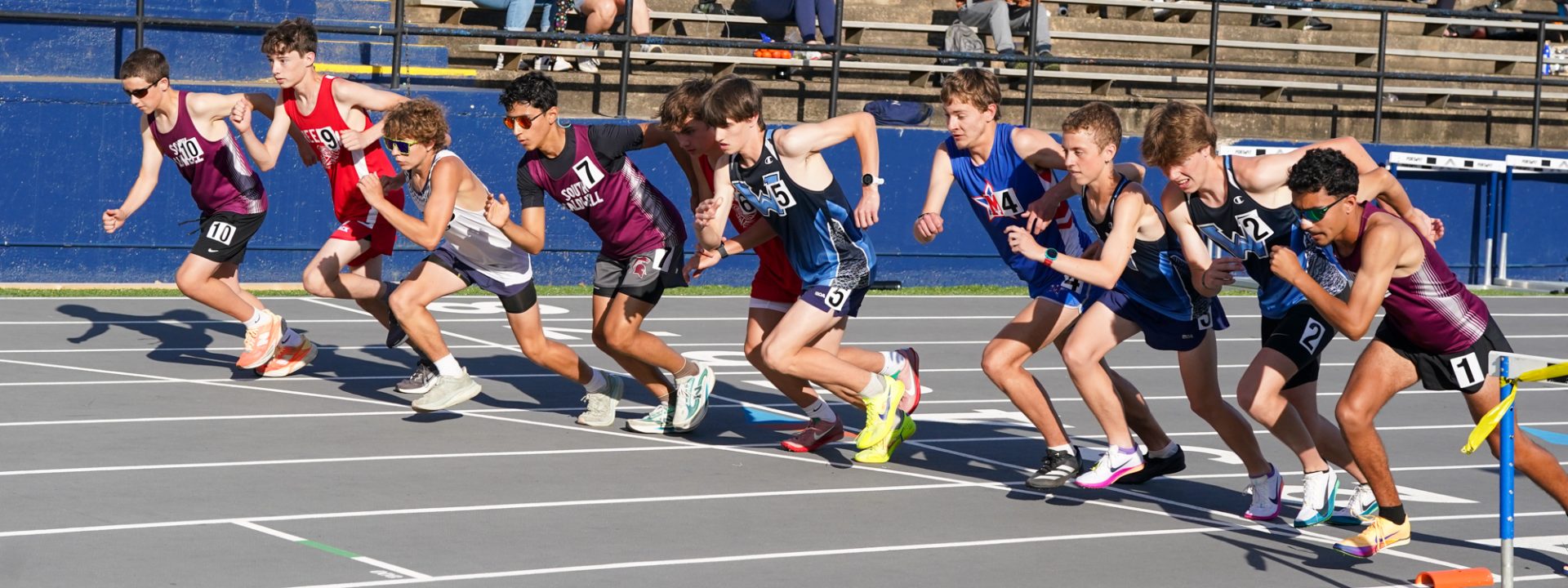
By David Rogers. CONCORD, N.C. — Kudos to the organizers of the NCRunners Middle School All-State Track and Field Championships on May 2, hosted by Jay M. Robinson High School. One hundred and forty-one (141) North Carolina middle schools were represented, including 25 Watauga District 6th, 7th and 8th graders. Watauga didn’t win any state titles this year, but when you consider that most of the events had upwards of 100 athletes competing — in each event — just qualifying to be there was an accomplishment unto itself.
FLYING HIGH: Watauga’s Johnny Reed earned a No. 19 finish competing against 41 other middle school athletes in the NCRunners middle school state meet on May 2. Photographic image by Jared Everett for Blowing Rock News
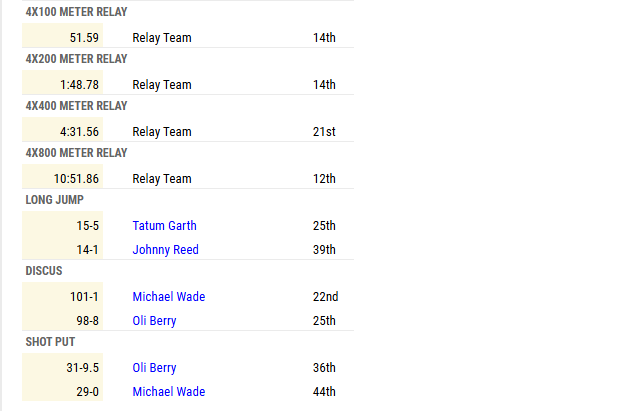
Here is a summary of the Watauga performances. The meet did not distinguish between the grade levels, so 6th graders were competing against 7th and 8th graders.
By David Rogers. TAYLORSVILLE, N.C. — With the NCHSAA 6A Regionals just two Saturdays away, May 9 at Asheville’s A.C. Reynolds High School, the Watauga men’s and women’s track and field teams had quite a “tune-up,” both claiming Northwestern Conference team championships on April 29 at Alexander Central High School — in dominating fashion.
WOMEN’S DIVISION
TEAM STANDINGS
Watauga (278)
Alexander Central (174,5)
South Caldwell (68)
St. Stephens (65)
Freedom (63.5)
McDowell (35)
We have to lead this accounting of the Watauga women’s team performances with a nod to sophomore Cali Townsend and freshman Josie Mayo.
Townsend competed in the 1600 Meters, the 3200 Meters, winning both long distance races. Josie Mayo? All she did was run on the winning 4×800 relay team, come in No. 2 in the 3200 Meters and No. 2 in the 1600 Meters.
“We call Josie’s 3-race performance ‘The Trio of Death’ because of how demanding it is to compete in those three distances in a single track event. The only ones to do it have been Josie (‘our FRESHMAN!’) and Cali,” said Watauga running coach J. Scott Townsend.
The Watauga women won each of the four relays, the 4×200, the 4×100, the 4×800 and the 4×400. In the individual events, the greatest curiosities were when the Pioneers didn’t have all three of their entries in the top five, if not a 1-2-3 sweep. The 4×800 Relay started this off, with Watauga finishing No. 1 (10:46.13), roughly 28 seconds ahead of second place St. Stephens (11:14.38).
Watauga had only two entries in the Women’s 100m Hurdles, going 1-2 with Tessa Buchanan (No. 1, 15.47) and Grace Scantlin (No. 2, 17.70). The Pioneers didn’t make the podium in the Women’s 100 Meters, but all three entries finished in the Top 10, including Charlotte Rosenbalm (No. 5, 13.45), Sophia Kop (No. 7, 13.64) and Gracyn Phelps (No. 9, 13.70). Malayah Adams of Alexander Central won the race with the only time under 13 seconds (12.39), but the rest of the field was tightly bunched with 10 runners between St. Stephens’ Ady McHenry (No. 2, 13.23) and McDowells Azmond Carson (No. 11, 13.97)
It was an exciting start to the afternoon’s competition. The Women’s 4×800 Relay could well have been the most exciting event of the day with No. 1 Watauga (1:49.29) barely edging out No. 2 St. Stephens (1:49.49). When you consider that each athlete on a team ran the equivalent of a half mile and the total distance run by each team was the metric equivalent of two miles, to have the finish come down to two-tenths of a second is a thrilling race. The Watauga foursome was Sydney Townsend, Lainey Johnston, Lily Kimbrough and Josie Mayo.
Cali Townsend continued her season-long excellence in the 1600 Meters event, finishing No. 1 (5:41.29), just over eight seconds ahead of the Pioneers’ Josie Mayo (No. 2, 5:50.23) and another three seconds ahead of teammate Lily Kimbrough (No 3, 5:53.73). The Pioneers’ 1-2-3 sweep was a statement as the only athletes under six minutes. No. 4 went to McDowell’s Elyse Foster (6:32.97).
In the 100m Hurdles, the first individual event, Tessa Buchanan and Grace Scantlin got Watauga off to a promising start with a 1-2 sweep of the event, Buchanan at No. 1 (15.47) and Scantlin at No. 2 (17.7).
The Pioneers may not have had any sprinters among the leaders in the individual 100 Meters sprint race, but apparently they have greater roster depth than the rest of the conference because they took the 4×100 Meters Relay (51.41), again by an eyelash over the runner up team, Alexander Central (51.63) for an exciting finish. Watauga’s quartet was comprised of Gracyn Phelps, Tessa Buchanan, Sophia Kop and Charlotte Rosenbalm.
Watauga’s Charlotte Rosenbalm brings home the baton on the final leg of the Women’s 4×400 Relay on April 29 in the 6A/7A Northwestern Conference meet. Photographic image by David Rogers for Blowing Rock News
All three of Watauga’s entries in the Women’s 400 Meters finished in the Top 10, capped by Lily Stough’s No. 1 victory (58.61), the only runner in the event to eclipse the 1-minute mark. South Caldwell’s Sarah Franklin took the No. 2 spot (1:01.37), followed by No. 3 Ava Cooke of Freedom (1:01.39). Watauga’s Vivian Hans (No.6, 1:04.35) and freshman Ember Honeycutt (No. 7, 1:04.49) picked up valuable team points with their finishes.
The Women’s 300m Hurdles was another 1-2-3 sweep for the Pioneers, with Tessa Buchanan (No. 1, 46.32). Grace Scantlin (No. 2, 52.28) and Hannah Kop (No. 3, 52.90). The figured as role models for the Pioneers’ entries in the 800 Meters, with Cali Townsend (No. 1, 2:20.46), Lainey Johnston (No. 2, 2:24.34) and Lily Kimbrough (No. 3, 2:33.55) following suit for yet another 1-2-3 sweep for the Pioneers.
Although Watauga didn’t have anyone place on the podium in the earlier 100 Meters, the 200 Meters sprint race was a different story. Alexander Central’s Malayah Adams won the event (No. 1, 26.28), but Watauga had the next two finishing spots, both within about a half-second of the winner: Mackenzy Cheek (No. 2, 26.78) and Tessa Buchanan (No. 3, 26.92). Merritt Powell also made the top 10, finishing No. 7 (28.39).
The final individual running event of the evening was arguably the Pioneers’ most dominating: the 3200-Meter Run. Cali Townsend (No. 1, 12:05.09), Josie Mayo (No. 2, 12:20.53) and Susanna Goff (No. 3, 12:23.03) lapped the field in taking the 1-2-3 sweep and demonstrating Watauga’s long distance superiority, at least in the 6A/7A Northwestern Conference. South Caldwell’s Kaylee Teague ran a respectable 15:44.09 at No. 4, well ahead of her No. 5 rival, Hope Cox (16:00.75), representing Alexander Central, but put in perspective, all three of Watauga’s athletes were more than three minutes ahead of the field, running near or under their personal bests.
In the final women’s relay, the iconic 4×400, Watauga (No. 1, 4:19.64), held off a game performance by Alexander Central’s quartet (No. 2, 4:29.40), as well as St. Stephens (No. 3, 4:36.66). The Watauga relay team members: Vivian Hans, Hannah Kop, Mackenzy Cheek and Eden Krenzin.
In the field events, Watauga continued its domination with most of the teams’ athletes finishing in the top five, if not winning. The Pioneers took a 1-2-3 sweep of the Pole Vault behind Sydney Helms (No. 1, 10-09), Sophie Robbins (No. 2, 9-06), and Carrie Bradbury (No. 3, 9-00).
The Pioneers’ Lily Stough (No. 1, 19-02) captured the Long Jump conference title, with Ember Honeycutt (No. 4, 15-11.50) and Eden Krenzin (No. 5, 15-10) rounding out the top five and capturing valuable team points.
Stough also showed well in the High Jump, placing No. 2 (5-02) behind Alexander Central’s Kay’ona Connor (No. 1, 5-04). Ashlyn Smith was Watauga’ only other entrant in the event, in the mix at No. 4 (5-00).
In the demanding Triple Jump, Stough again led a trio of Pioneers, all placing in the top five of the event. Stough captured the conference title with a leap of 40-04, more than four feet further than No. 2, Alexander Central’s Carly Hendren (35-10.25). Watauga’s Eden Krenzin (No. 4, 34-03) and Sophie Kop (No. 5, 33-08.25) rounded out the top five. Alexander Central also had the No. 3 jumper in Cadence (“Cadee”) Rollins (35-00).
Alexander Central’s Ali Lewis was a double winner in capturing the Shot Put and Discus titles, going 31-07 in the Shot Put and 198-04 in the Discus. While the Pioneers didn’t place anyone in the top five of the Shot Put, two Watauga athletes made it to the top five list in the Discus: Ellie Helms (No. 2, 96-03) and Maggie Smith (No. 5, 84-05).
Mars Hill University bound Matthew Leon (to play football) of Watauga was a double gold medal winner on April 29 in the 6A/7A Northwestern Conference track meet. Photographic image by David Rogers for Blowing Rock News
MEN’S DIVISION
TEAM STANDINGS
Watauga (218)
Alexander Central (151)
St. Stephens (122)
Freedom (66)
South Caldwell (63)
McDowell (58)
Watauga won three of the four relay events, capturing the 4×100, 4×200 and 4×800. A lane violation in the 4×400 resulted in a disqualification.
The 4×800 team of Grady Gates, Levi Anderson, Brian Newmark and Calvin Zwetsloot got the Watauga men’s team started on the right foot, capturing the conference title with an 8:54.07 performance, a little more than 11 seconds ahead of No. 2 Alexander Central (9:05.62).
The 110m High Hurdles event was won by St. Stephens’ Kion-nie Banks (15.66), followed by the Pioneers’ Eli Reed (No. 2, 16.42)
.Watauga’s Nyle Peays led a 1-2 sweep of the 100 Meters, sprinting the distance in 10.66 seconds. He was followed by No. 2 Riley Ellison (10.93), the only two competitors under 11 seconds.
In the 4×200 Relay, the Pioneer quartet of Matthew Leon, Lucas Cash, Mason Harris and Riley Ellison were crowned conference champions, winning the event in 1:30.27.
James Bostrom of Watauga clocked a 4:37.14 time to secure the 1600 Meters title. Teammates Jonah Pearson (No. 3, 4:38.68) and Zeke Walker (No. 4, 4:45.04) were not far behind No. 2, Bryce Corpening of South Caldwell (4:38.06).
Watauga similarly showed off its sprint prowess in the 4×100, with the quartet of Mason Harris, Riley Ellison, Lucas Cash and Nyle Peays completing the one-lap circuit in 43.37 seconds, with Alexander Central No. 2 (44.11).
Pioneer senior Matthew Leon was the only Northwestern Conference performer to run under 50 seconds in the grueling 400 Meters sprint. His No. 1 time of 49.42, a personal best, allowed him to cross the finish line ahead of Alexander Central’s Aidan Batty (No. 2, 50.24) and Kevin Hinson (No. 3, 51.32). Leon revealed to Blowing Rock News that he has committed to play football next year for Mars Hill University, north of Asheville.
Far right, Bryce Corpening of South Caldwell has the inside edge at the start of the Men’s 3200. Corpening won, closely follwed by a 2-3-4 finish for Watauga’s Parker Williams, Calvin Zwetsloot and Isaac James. Photographic image by David Rogers for Blowing Rock News
Nyle Peays and Eli Reed completed a 1-2 sweep in the Men’s 300m Hurdles. Peays was No. 1 (39.38) and Reed was No. 2 (40.74).
Watauga’s entries in the Men’s 800 Meters took another 1-2-3 sweep to the podium, with Levi Anderson (No. 1, 2:04.72), Zeke Walker (No. 2, 2:05.40) and Brian Newmark (No. 3, 2:06.20) taking the honors.
The Pioneers followed that up with 1-2 sweep of the Men’s 200 Meters, with Nyle Peays again leading the way at No. 1 (21.69), followed by Riley Ellison (No. 2, 22.35). Mason Harris (No.4, 23.53) was also among the leaders.
South Caldwell’s cross country and long distance star Bryce Corpening showed his stuff again in the Men 3200 Meters, going No. 1 in 10:11.39. He was followed by a trio of Watauga runners: Parker Williams (No. 2, 19:16.49), Isaac James (No. 3, 10:21.77) and Calvin Zwetsloot (No. 4, 10:30.93).
In the final event of the day, the Men’s 4×400 relay, Watauga was represented by Silas Powell, Sawyer Blackburn, Derek Nix, and Eli Reed, but was disqualified for a lane violation on one of the baton exchanges.
By David Rogers. HICKORY, N.C. — Good business models often capture complementary revenue streams — and that’s exactly what Rock Barn Country Club aims to do with its ongoing renovation and expansion plans.
It is a “club”, to be sure, with members, dining facilities and recreational amenities, as well as a spa and fitness center. Among its recreational opportunities are two golf courses, a members and member-guests course designed by Robert Trent Jones, Jr., as well as another course designed by Tom Jackson that is more readily playable by the public.
Left to right, Ron Cutlip, Jon Robertson, Brad Ellinger and Marshall Robinson discuss the new features of the bunker renovations at Rock Barn Country Club. Photographic image by David Rogers for Blowing Rock News
Rock Barn is also a popular spot for hosting events, including weddings, receptions and business conferences. Somewhat central to Rock Barn’s operations is the spa, which attracts add-on revenue from every other aspect of the operation: membership, golf, tennis, lodging and retail.
While Rock Barn currently has a lodge that accommodates groups of 10-12 people for overnight stays, in a recent interview with Blowing Rock News, General Manager Brad Ellinger reported that a high-end, boutique hotel is in the planning stages.
“Rock Barn is a destination for many people in our wide geographic market footprint,” said Ellinger, “so we need individual rooms for couples and individuals to serve that market demand. We are a coveted venue for weddings and other special events, so rather than force customers to overnight stays in Hickory, Statesville or Charlotte, for example, our boutique hotel will offer a more convenient option. We expect the spa will also see additional market demand because of the hotel’s draw.”
Playing Through
Another Rock Barn operation that promises to complement the hotel and the spa are the golf courses.
“We are restoring the Robert Trent Jones, Jr. course back as close as possible to its original design,” said Ellinger, “and we want it to be in prime shape for our members and guests well before the new hotel opens. The key focus is on renovating the bunkers and we are excited about the work that is currently being done.”
Studying the bunker renovations currently ongoing at Rock Barn’s Jones course is a multi-dimensional journey into history, architectural design, technology and business. It is an ambitious project, with more than 130 bunkers — AKA “sand traps” — dotting the 7,169 yards of scenic sporting landscape.
Rock Barn’s Golf Course Superintendent Jon Robertson points to bunker erosion that developes over the years on any golf course. Rock Barn is renovating its bunkers to restore the original Robert Trent Jones, Jr. design. Photographic image by David Rogers for Blowing Rock News
Understanding Golf’s Roots
Bunkers on golf courses evolved over time. Early golf was played on Scottish coastal “links” courses where natural, wind-swept sand depressions occurred naturally while grazing farm animals created sandy “hollows.”
Today’s golf courses are no longer modified sheep and cow pastures. Modern bunkers grew out of these natural hazards to make golf more strategic. The threat of a player’s ball landing in a sand trap increases golf’s difficulty for most. Skilled professionals might purposely navigate their ball into a sand trap to get closer to the hole but bunkers challenge a golfer to hit the ball more precisely, to safer landing areas for playing a next shot.
Today’s sand traps honor golf’s origins but they also serve a more practical double-purpose, too: adding beauty to the course experience while encouraging a more profitable course operation.
“The Jones course opened in 2003,” said Rock Barn’s Director of Golf, Marshal Robinson. “Over two decades of play, we found that some of the bunker edges had risen two to three inches as golfers played out of the sand. It may only be a little bit of sand thrown up on those edges at any given time, but it accumulates. So, one of the reasons driving this renovation is the aesthetic value of restoring the bunkers.”
Rock Barn contracted High Country-based Cutlip Golf Design to lead the renovation project. Cutlip added Blowing Rock native Rick Robbins to the design team. Robbins is a past president of the American Society of Golf Course Architects and Ron Cutlip was inducted into that prestigious organization in late 2024.
New bunker technology uses a layer of Portland cement mixed with sand to quickly channel water from rainfall to drainage channels at the lowest points of the sand trap, below the white sand you typically see. Embedded in those channels are ‘chambers’ for collecting the water and directing it out to the course periphery. Photographic image by David Rogers for Blowing Rock News
Cutlip and Robbins collaborated on designing the master plan for the bunker renovation, meticulously reviewing the Jones course, hole by hole. It was Cutlip’s experience on his last major project, designing the South Shore Golf Club course in Narragansett, Rhode Island, that answered a critical question for the Rock Barn management team.
“Ron (Cutlip) told us about a newer bunker technology that we had never heard of,” said Rock Barn’s GM, Ellinger. “It sounded interesting, but we were skeptical of investing in something with which we were unfamiliar. We became convinced, though, after the technology contractor provided us with a risk-free demonstration, renovating what was ostensibly our worst bunker to show us how it works.”
On a golf course, water-logged bunkers can slow down play.
“Golf course businesses make a lot of their money based on the number of rounds that can be played in a day,” said Cutlip. “When it rains, the older style of bunker often gets water-logged. It becomes unplayable. We are introducing newer technology with this renovation project, the same technology we used at South Shore in Rhode Island.”
Enter Mark Pribble, of Atlantic Installations, based in Maryland.
“My business partner and I saw this unique construction-related process in a completely different application and thought it could have profound implications for golf course sand traps,” said Pribble. “So we negotiated to license the technology for golf course applications. Below the layer of white sand that you see in a bunker, there is a layer of Portland cement mixed with sand. This layer quickly channels the water from rain into chambers at the bottom of each bunker. Each chamber is able to handle a very large volume of water, then releases it into drainage pipes that direct it to the course periphery, into creeks and ponds or spread out over wetlands. This technology leaves the top surface of sand dry and more readily playable, which speeds up play as well as enable play.”
The chambers to collect the drained water from a bunker have fine perforations to allow water to pass through but holding back sand and gravel. Photographic image by David Rogers for Blowng Rock News
Going Pro
One of the NCAA’s most memorable taglines was introduced in the early 2000s: “There are more than 400,000 college student athletes in the U.S. and most of them will go pro in something other than sports.”
Certainly that was true for Jon Robertson, Rock Barn’s golf course superintendent. In the late 1990s, he was on App State’s football team as a quarterback but after graduating he pursued another passion as his professional occupation: in golf course management.
Bunker course nearing completion (foreground) provide a sharp contrast to a nearby bunker just getting carved back down to ‘ground zero’ as part of Rock Barn’s renovation and restoration project in the spring of 2026. Photographic image by David Rogers for Blowing Rock News
“These bunker renovations are more player friendly, aesthetically pleasing, improve the lines of sight, and help with our golf course maintenance,” said Robertson. “Like a lot of courses, we use ‘Sand Pros’ to power sweep the bunkers. With our old bunkers, these devices were also a source of erosion as they break down the edges going in and out. With the new bunkers, that process is made much more efficient. That’s going to not only improve the aesthetics, but help out our maintenance crews, too.”
From a design perspective, bunkers can define a golf hole. They add visual contrast to the playing experience (white sand vs. green turf, for example) but fairway bunkers are strategically placed to challenge both the golfer’s skill and his or her decision-making: “Do I play it safe or try to carry the bunker and get closer to the pin?” Around the green, bunkers serve to “protect” a hole, challenging the golfer’s hitting precision.
Placing bunkers — sand traps — on a golf course reveals the mischievous devil at work in the minds of golf course architects. They create beauty and deception – and now also help a course’s management.
EDITOR’S NOTE: We plan a follow-up story with images during the summer, once the grass has “greened up” and the planted turf has matured.